My Gettysburg Address: Reliving America on the Cusp of its 250th
DIY Study Abroad
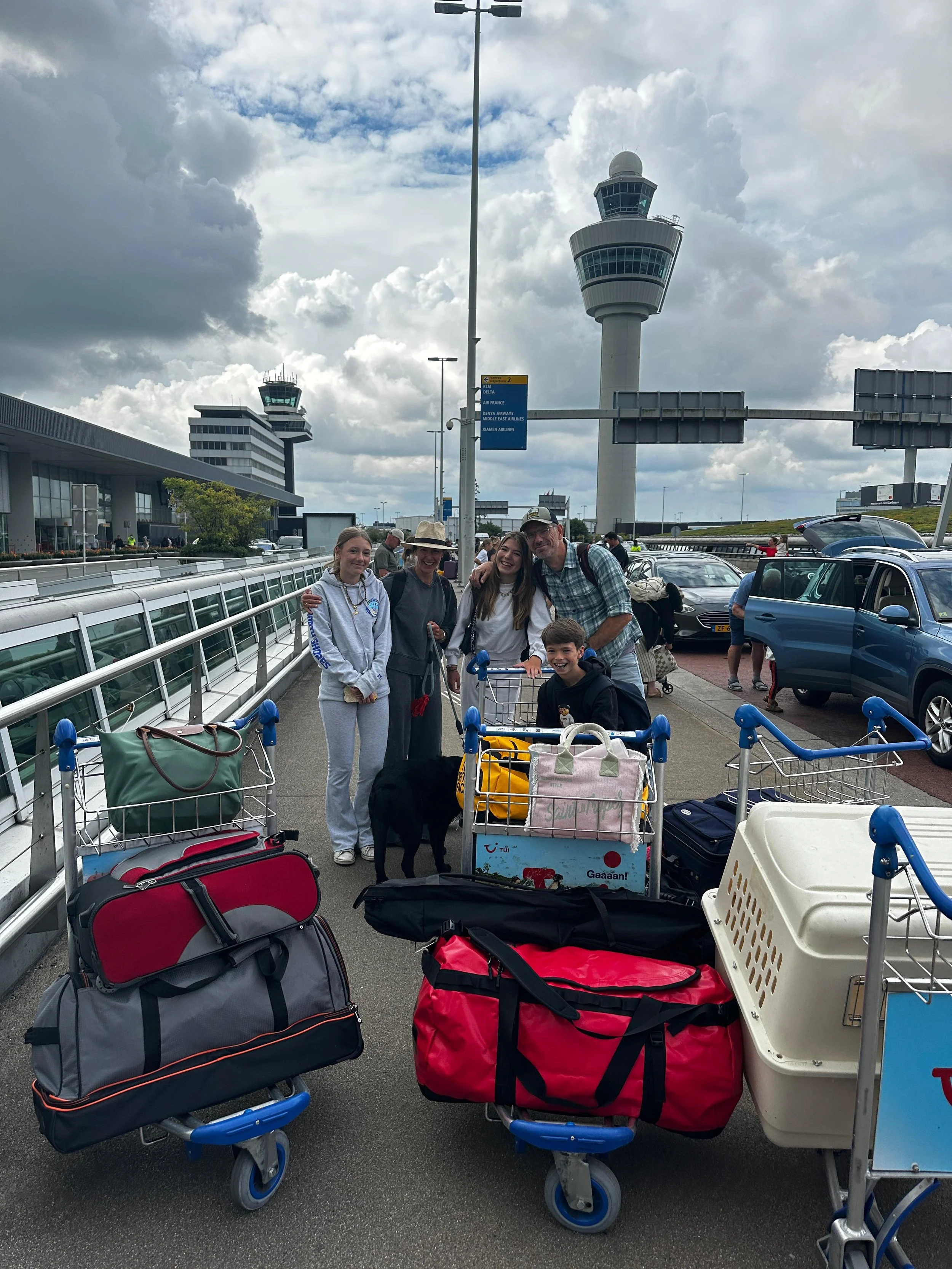
Hannah with her family on departure day at Schiphol Airport, Amsterdam, July 2025.
One score and two years ago, I left my hometown of Gettysburg, Pennsylvania, to pursue life, liberty and happiness. That pursuit entailed moving to the Netherlands, a country I was first exposed to in high school, as an exchange student. I traded my car for a bike, my Cheerios for cheese on bread, and rolling hills, apple orchards, and Civil War battlefields for flat landscapes dotted with wind turbines and endless rows of tulips.
A combination of love and grad school had brought me back. I met my now-husband, who grew up in Groningen, at the Dutch embassy in Washington, D.C., my first job out of college. We fell for each other and, after living together for two years in the nation’s capital, moved to Amsterdam so I could obtain my master’s degree from the University of Amsterdam.
I never know whether to use the word immigrate or emigrate, since the difference is based on perspective. Immigration is the act of moving to a new country, while emigration is the act of leaving one's country to live somewhere else. Although I chose to move to the Netherlands in 2004, in the end, it meant leaving America, with no plans of returning home anytime soon. And, in recent years, as doomsday headlines continued to amass in my inbox, the idea of moving back permanently became less and less attractive.
I was, however, intrigued by the idea of spending some quality time back home—which would allow me to reconnect with my roots and share the experience of “growing up American” with my three children, all of whom were born in the Netherlands.
In the years I’ve lived abroad, I have traveled back to the hometown that I love so much, but only for about three weeks each summer. That has meant that, for the most part, I have been confined to observing America from the sidelines, reading and watching (mostly negative) news about school shootings, the opioid epidemic, and increased political polarization and violence. We have our fair share of problems in the Netherlands, to be sure, but when you see such troubling news coming from your home country, and with such regularity, it hurts. Was the America I remembered so fondly a thing of the past? Had it really changed so much from the place I knew growing up in the ʼ80s and ʼ90s?
My Dutch husband says I’m hopelessly sentimental. And he’s right. But who doesn’t like to reflect on the good things about their childhood? For me it’s junior high dances with Led Zeppelin's “Stairway to Heaven” as the last song, the smell of honeysuckle on a summer bike ride through the battlefield, and hanging out on the hill at Friday night football games, sucking on a sour apple Blow Pop. I wanted my Dutch kids to know the country I knew growing up—the country where Democrats and Republicans played cards together, where community was a given, whether it was achieved through one’s church, the local swimming pool, or a fundraiser to help a neighbor who had happened upon tough times. I was curious to see if that sense of community still existed, the same way it had for me when I was growing up in small town America.
I had long known that if we wanted to embark on a DIY study abroad program as a family in America, it would have to be when my oldest was a sophomore in high school, as the Dutch education system doesn’t allow for much flexibility during the exam-heavy 11th and 12th grades. This window of opportunity would allow me to revisit my hometown—no longer a student of the Gettysburg School District, but a parent; no longer a summer visitor, but a borough resident—through the lens of someone who had missed day-to-day life in America for at least two decades and who was used to an entirely different educational and social system.
“Twenty years from now, you will be more disappointed by the things you didn’t do than by the ones you did.” – Mark Twain
This adage kept playing over and over in my head as I was struggling to decide whether to move forward with this make-shift study abroad in the fall of 2025. Did I really want to expose my kids to schools that feature mandatory “active shooter” drills? Would the experience mar my idealized memories of my own childhood? Could I put my blinders on to the Trump circus and hope for the best?
Indecision can be debilitating. April, May, June—the months flew by and meanwhile my youngest daughter kept asking, “Are we going?” She was really looking forward to the prospect of experiencing America as a local. But I wasn’t so sure that I wanted to go. My family and I were comfortable in our small Dutch village, our relatively safe bubble just outside Amsterdam. My hesitation was wholly based on fear. But of all the things I worried about, my biggest fear was that I would regret not going. And, so, after suffering through a long list of logistical tasks—registering the kids at three American schools (elementary, middle, and high school), packing, finding a suitable house to rent, leasing our place in the Netherlands, and booking plane reservations, including for the dog (whose ticket was just as expensive as ours!)—off we went.
Celebrating 250 Years of Independence
It’s a total coincidence that my family and I embarked on our study abroad program on the eve of America’s Semiquincentennial, the 250th anniversary of the Declaration of Independence.
Four months into our stay, on November 19, I attended a lecture at the Majestic, a century-old theater in downtown Gettysburg, celebrating the anniversary of the Gettysburg Address, the 272-word speech President Abraham Lincoln delivered to dedicate the national cemetery that was established in the aftermath of the bloody battle that had taken place in July 1863. One of the panelists, Prof. Drew Gilpin Faust of Harvard, pointed out that Lincoln never used the word “I” in the Gettysburg Address, only “we” and “our,” because his speech was about “us,” about we, the people. A man of integrity, empathy, and emotional discipline, Lincoln didn’t make it all about him, unlike the leadership we’re seeing today. Another speaker, Prof. Stephanie McCurry from Columbia University, said, “America is an ongoing terrain of struggle.” As these brilliant historians opined on this great man and the speech he had given 162 years before, I couldn’t help but connect it to my own experience of being back in America and the upcoming anniversary of our Declaration of Independence.
Thomas Jefferson's masterpiece provided profound inspiration for Lincoln's brief but achingly poignant remarks at Gettysburg. By framing the Civil War as a test of America's founding ideals—that people (well, rather, white, land-owning men) have inherent rights to life, liberty, and the pursuit of happiness—Lincoln redefined the war's purpose, shifting it from preserving the Union to fulfilling the Declaration's promise. At the end of his speech, he called for a "new birth of freedom" that would ensure government "of the people, by the people, for the people" would not perish from the earth.
One of the most revolutionary ideals put forth by Jefferson in 1776 was that governments derive their power to rule from the consent of the governed, and that whenever that government “becomes destructive of these ends,” it is the right of the people, “their duty,” to “throw off such Government, and to provide new Guards for their future security.” While I’m not suggesting that we throw the whole thing out and start over, thinking about Jefferson’s words while I sat in a theater in Gettysburg, the place where the nation he so passionately argued for in 1776 was preserved, certainly gave me pause, and potent food for thought.
This lecture, combined with five months of living among my fellow Americans in my hometown, have inspired me to reflect on my own observations of the country I grew up in and the country I see today. And while it’s easy to get lost in all of the bad things that are happening, I was determined to focus on the good, the “better angels of our nature,” as Lincoln put it in his first inaugural address, in the hopes that we can right this ship and bring America back in line with its founding ideals.
America does seem to be, in Stephanie McCurry’s words, “an ongoing terrain of struggle,” and maybe it always will be. I don’t have all the answers, but here are five ways that the heart of the America I knew and loved when I was a young—the America I’m nostalgic for—is still beating.
"Teach the children so it will not be necessary to teach the adults." – Abraham Lincoln
Seeing the teachers in action at the schools my kids attended made me want to become one myself. (Unfortunately, I don’t have the patience, nor a teaching degree.) There’s something about the educators in my hometown that made me realize how dedicated teachers are and what a crucial role they play in shaping future generations. Many I spoke with have been teaching for decades and their passion is evident. I regularly witnessed teachers who told jokes or roleplayed with the kids to keep their attention, supplied generous hugs before students boarded their buses, and attended school sporting events. Many of them even coached sports on the side. Call me a nerd, but I got butterflies in my stomach at the back-to-school “Meet the Teachers” night when one of my children’s science teachers talked about how her students should start collecting packaging material at home in preparation for learning about volume and measurements. Her enthusiasm for the subject matter was contagious. My tenth-grade daughter’s business teacher lent her one of the many extra sweatshirts he had hanging in the closet when she said she was cold. He talked to her about deer hunting, practically a religion in Pennsylvania, and offered her venison to take home to her family. Seeing as she’s vegetarian, she declined his offer, but we were all impressed by these small, thoughtful gestures.
In the Gettysburg school system, kids aren’t allowed to have their phones at lunch and the students are provided an actual cafeteria in which to sit down and eat. This was a far cry from kids wandering the halls or sitting with their phones during lunch, as happens in some schools in the Netherlands. My children say they’ll miss the teachers and the cafeteria and the meals they serve there the most. (Who wouldn’t prefer Salisbury steak and tacos for lunch to soggy sandwiches?!) This opportunity to sit down and eat together, sans devices, allowed my kids to make friends and engage in meaningful conversation—and provided welcome but subtle encouragement to engage with the world around them.
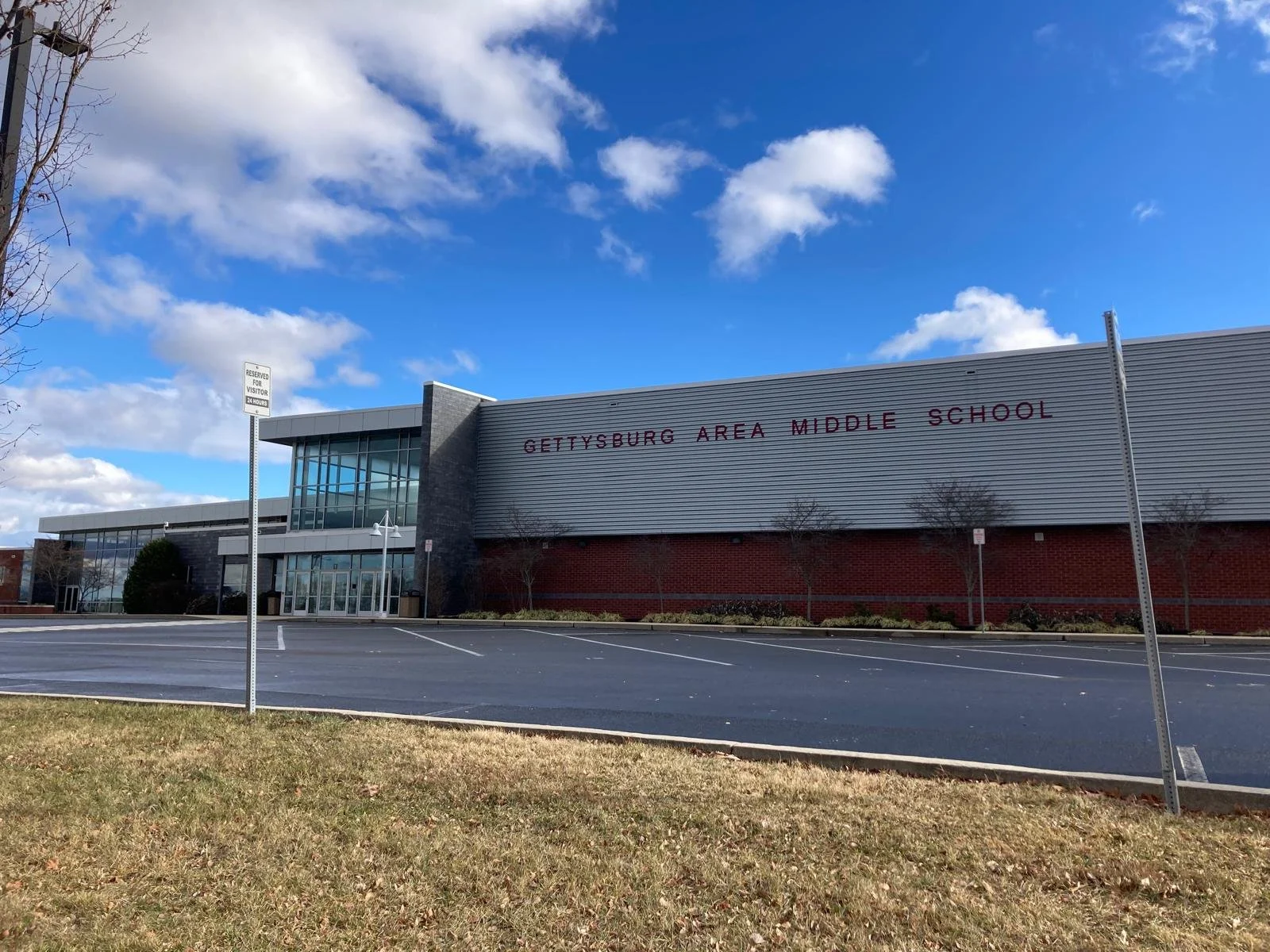
Gettysburg Middle School (Photo by Hannah Huber)
"A single act of kindness throws out roots in all directions, and the roots spring up and make new trees.” – Amelia Earhart
I had forgotten that every school day began with morning announcements and a recitation of the Pledge of Allegiance. Through a Dutch lens, this civic ritual seemed excessively patriotic and nationalistic. But, then again, as someone who grew up with it, I had a new appreciation for, here’s that word again, the sense of community it instilled. After dropping off my son at Lincoln Elementary—named after, you guessed it, Abraham Lincoln—I could often hear the principal’s voice projecting on the outdoor speakers. She ended her announcements each morning with a reminder: “Be kind to each other.”
The kids here are encouraged to give each other sincere compliments, and it shows. Never before have I and my children felt so comfortable in our skin. A woman rolled down her car window to tell my daughter how beautiful she was. A teenage girl passed my other daughter and told her she liked her outfit. Not only were my girls beaming, they received a major confidence boost. I’ll forever remember the woman who talked my ear off (in a good way) at the CVS about food supplements and the older man at the Giant grocery store who motioned for me to push my shopping cart ten yards towards him across the parking lot so he could put it back for me. And our neighbor, Roberta, who gave our dog two treats every time we walked by and clipped Gettysburg Times articles that mentioned our kids scoring in a game. It’s easy to meet people in small-town America; you can strike up a conversation with pretty much anyone. Even my Dutch friend who returned from a trip to New York City called me up to say how easy it was to make contact with people there, even on the elevator. Despite how Americans are portrayed in the news, there’s an openness and kindness here that I haven’t seen anywhere else.
"Climb the mountains and get their good tidings." – John Muir
I still think “America the Beautiful” is one of the loveliest “national” songs I’ve ever heard. I have sung it as a bedtime lullaby to my kids over the years, perhaps in an attempt to give them a dose of their Americanness. The song expounds on the sweep and splendor of the nation:
O beautiful for spacious skies,
For amber waves of grain,
For purple mountain majesties
Above the fruited plain!
And with the United States comprising approximately 3.8 million square miles, there’s a lot of ground to cover. The sheer enormity of the country (it’s at least 230 times the size of the Netherlands) and the diversity of its landscapes never cease to amaze me. The sweeping, rocky headlands of Acadia National Park in Maine, the epic grandeur of the Grand Canyon, the tropical palms of Florida. Each state seems to be its own country. (One that comes to mind is Washington, where the coastal city of Seattle quickly melts into mountainous pine forests, then transitions to a desert-like steppe landscape, all in one state!) America is huge and there’s something about this expansive space that frees the mind and inspires. The fact that you can find a Target and Wendy’s in pretty much every state, is a reminder, albeit a not-so-sexy one, that we’re all part of one shared nation. But with such a vast diversity of physical landscapes and people, it’s no wonder we are so hard to govern.
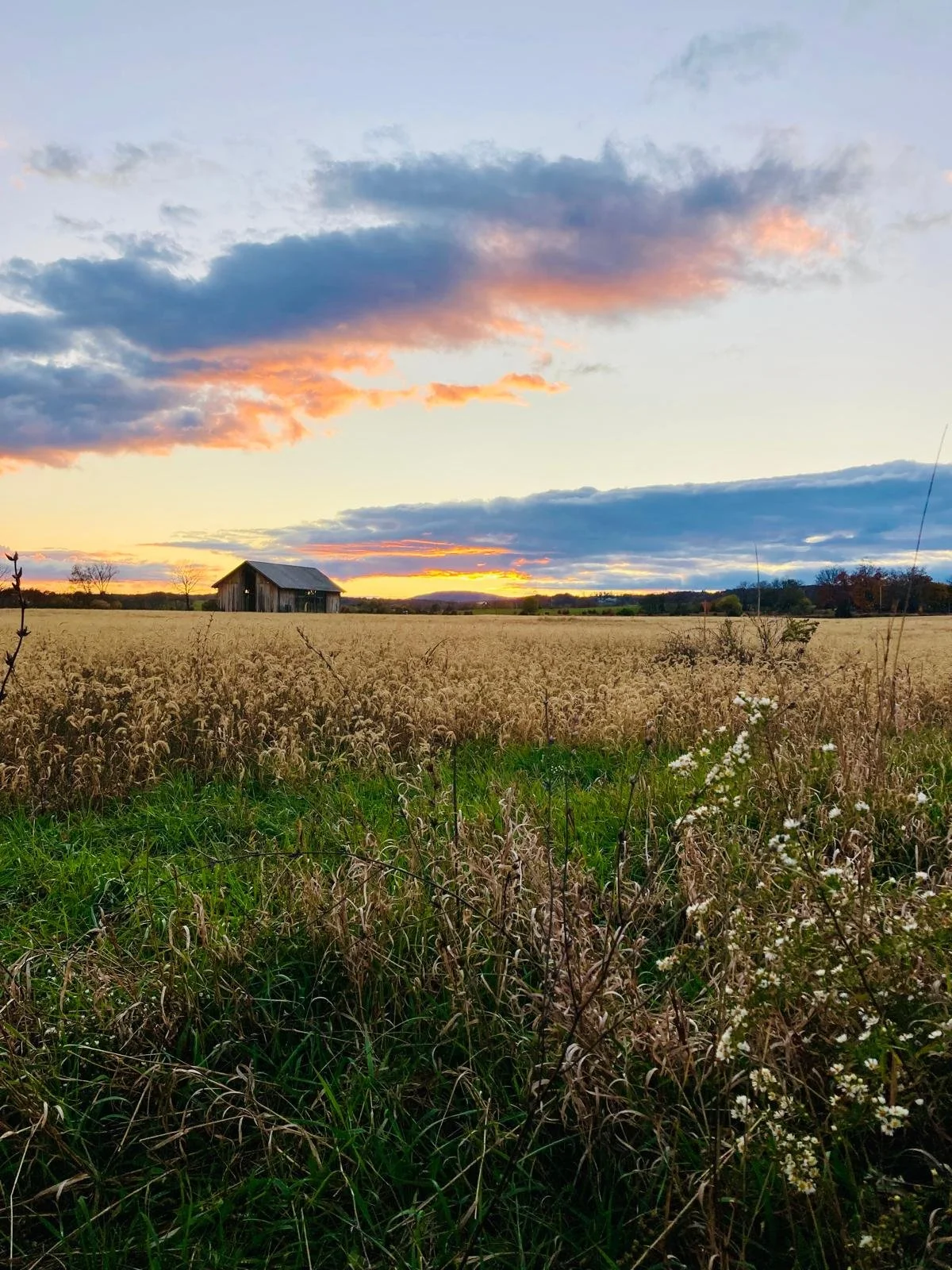
A Gettysburg Sky, taken by the Covered Bridge (photo by Hannah Huber)
"Diversity makes for a rich tapestry." – Maya Angelou
When I asked my kids what was different about American kids versus Dutch kids they said two things in particular. The first was the observation that more kids here went to church and how important their faith was to them. They said they’d witnessed classmates who posted about how much they loved Jesus on social media—this brought them a new perspective as they did not see this with their classmates back in the Netherlands.
Secondly, they said how they liked the diversity of people they encountered on a daily basis. One place where this was particularly apparent was from the bleachers at high school sports games. So many different walks of life sitting together in one place, so many different styles of clothing and ways to express oneself and one’s individuality. It was refreshing for my children to see how everyone was able to be themselves here, with less conformity. This is something that should be embraced as a source of national pride. But on a micro level, in towns like Gettysburg all across America, you can witness a true cultural mosaic in action.
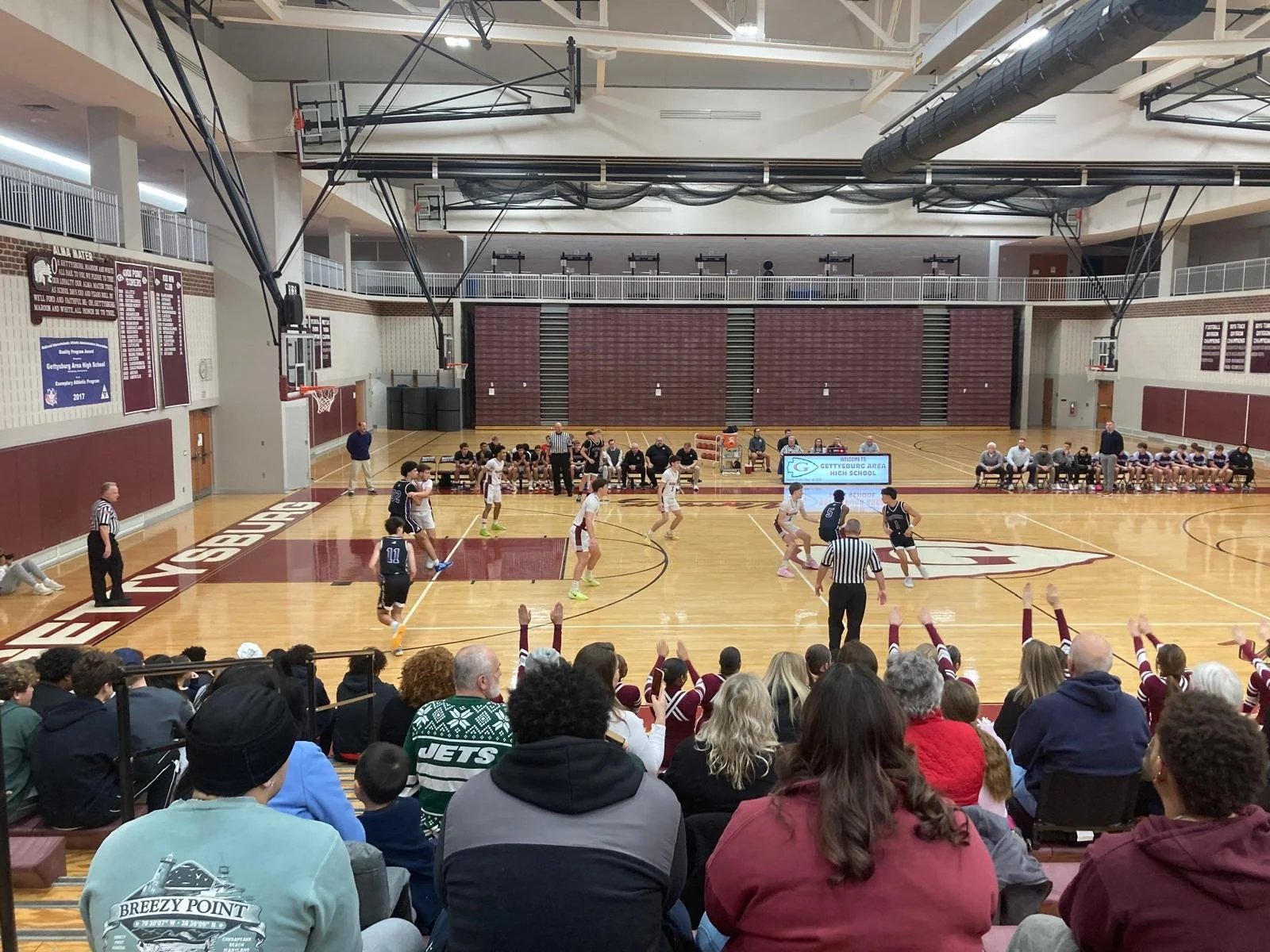
Gettysburg High School Boy’s Basketball Game (Photo by Hannah Huber)
“I never considered a difference of opinion in politics, in religion, in philosophy, as cause for withdrawing from a friend.” – Thomas Jefferson
All you have to do in order to know someone’s political stance is look in their front yard during election season. Although the First Amendment, guaranteeing freedom of speech, has been particularly challenged of late, the fact that people can place a sign in their front yard expressing the party or candidate they support, or what they stand for, is special, and something I hope can remain an enduring part of the American ethos. I saw lawn placards indicating a diverse array of opinions, from “This Battle Was Fought Because Black Lives Matter” and “Hate Has No Home Here” to “Don’t Tread on Me.” A friend of my parents popped in for a visit during my stay and said, “Americans just love being angry. We’ve gotten so used to it.” So how can we shed this anger? Upon being invited to a “girls’ night” hosted by one of my childhood friends, it became quickly evident that the five other women—all of us went to high school together—were split down the middle politically. It was a fun evening nonetheless and the one time political tension reared its ugly head, one of the women, a Republican, said to our Democrat friend, “We’re all entitled to our own opinion.” She quickly agreed, and that was that. And that’s how it should be. If only we could agree to disagree, while respecting each other’s opinions, and truly embrace the full meaning of freedom of speech, even when it applies to discourse we don’t agree with. Viewpoints can and should be challenged, but in the end, to be able to meet in the middle, walk through the same door, or have a drink together and laugh should be the goal. Judging by the coverage I see on the news, Americans seem to spend a lot of time disparaging the other side, as though they were loathsome strangers with whom they share little in common. Perhaps we should try a bit harder to embrace our diversity while taking care to remember that there’s a lot more that unites Americans than divides them.
Straddling Two Countries
As I sit here writing in the final days of our stay in Gettysburg, I can feel myself becoming increasingly anxious and sad. It’s a combination of knowing our five months are over, that definitiveness, but also the realization that I’ve chosen this dual-citizen life for myself. I have one foot in each place. It is a beautiful but difficult privilege to straddle two countries, and ultimately two identities. My heart swells with gratitude that we were even able to do this in the first place, that I was able to show my kids what it was like to live in my hometown of Gettysburg—a name most people in the world recognize because of what happened on these battlefields and Lincoln’s oratorial attempt to make sense of it.
In this time, I was able to experience so many small things that brought a smile to my face. Watching a high school field hockey game in the bleachers, the warm sun on my back, the sound of crickets at night, walking my dog around town and greeting strangers and friends with a wave. Getting to see my children have these same experiences was priceless. Though my oldest daughter was always mortified when I peeped my head out of the front door to watch her board yellow school bus #12 each morning, nothing made me happier than seeing her participate in this normal, everyday aspect of American life. I will tuck these past five months deep into my pocket so that I can carry their memory with me, always. It’s crazy to think we almost didn’t come out of fear or reluctance to leave our comfort zone.
Polarization is perhaps one of the most defining features of today’s America, but local communities are the building blocks of society. And in Gettysburg I saw a lot of effort among community members to engage and put together meaningful initiatives. In the face of national tension, we can choose to focus on the good, to listen to our “better angels.” In our own small ways, in our small communities, we can take the time to pay each other compliments, to be kind, to offer to help lighten the load of someone in need. Perhaps this is America’s backbone and will be the source of our enduring strength.
As Turkish writer Elif Shafak points out, our home countries will never abandon us. “They are shadows that tag along with us to the four corners of the earth,” she says. “Sometimes they walk ahead of us, sometimes they fall behind, but they are never too far.” That sentiment rings true to me right now more than ever as I contemplate the country I left more than 20 years ago and how it stacks up now in comparison. With the challenges facing the nation—and with worries over the economy, the environment, political violence, individual freedoms, and the future of democracy itself so front of mind—the United States may seem more divided than ever, but the promise of America, in all its complicated glory, remains. In The Radicalism of the American Revolution, Gordon Wood writes how Lincoln realized, quite astutely, that the beliefs outlined in the Declaration of Independence provided a framework that allowed people of diverse ethnicities, races, and religions to be brought together into a single nation. And on the eve of our 250th anniversary, I hope, as Lincoln did in the conclusion of his Gettysburg Address, "that that nation might live.”
HANNAH HUBER is the author of two books, Place and Queens’ Row. She founded Storyhouse Works, a boutique indie-publishing house for international authors. Hannah lives in a small village just outside of Amsterdam with her Dutch husband and three children.
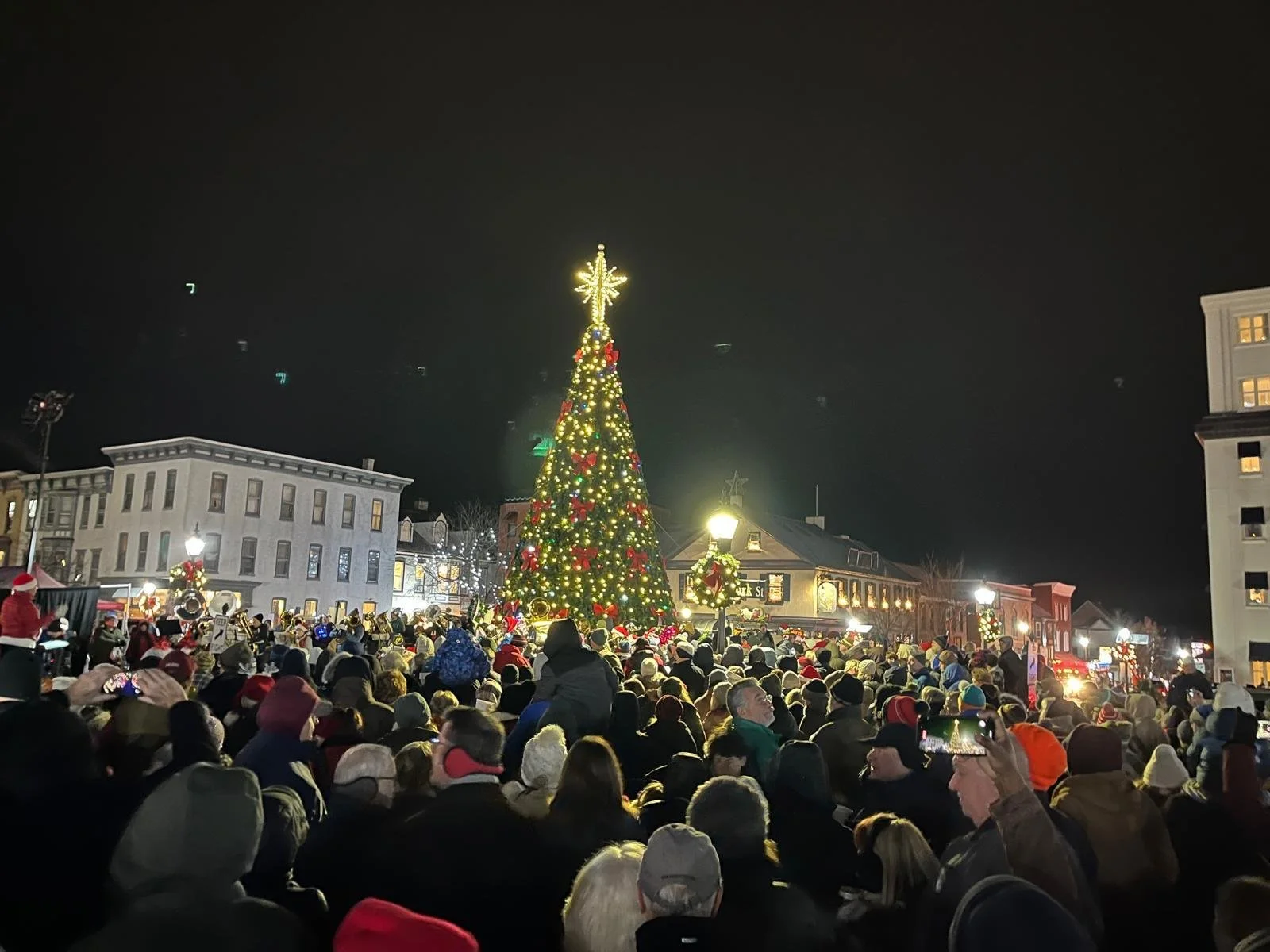
Christmas tree lighting ceremony on the Square of Gettysburg (Photo by Hannah Huber)